

In this article
Key takeaways
- Search no longer always leads to a click. It often ends with an AI-generated answer.
- Good content is no longer enough. Distributing it on other platforms matters as much as writing it.
- AI tools recommend brands that have something useful, credible and original to say.
- Visibility in AI answers can be measured, and few businesses do it yet.
- SEO remains the foundation. GEO builds on it, it does not replace it.
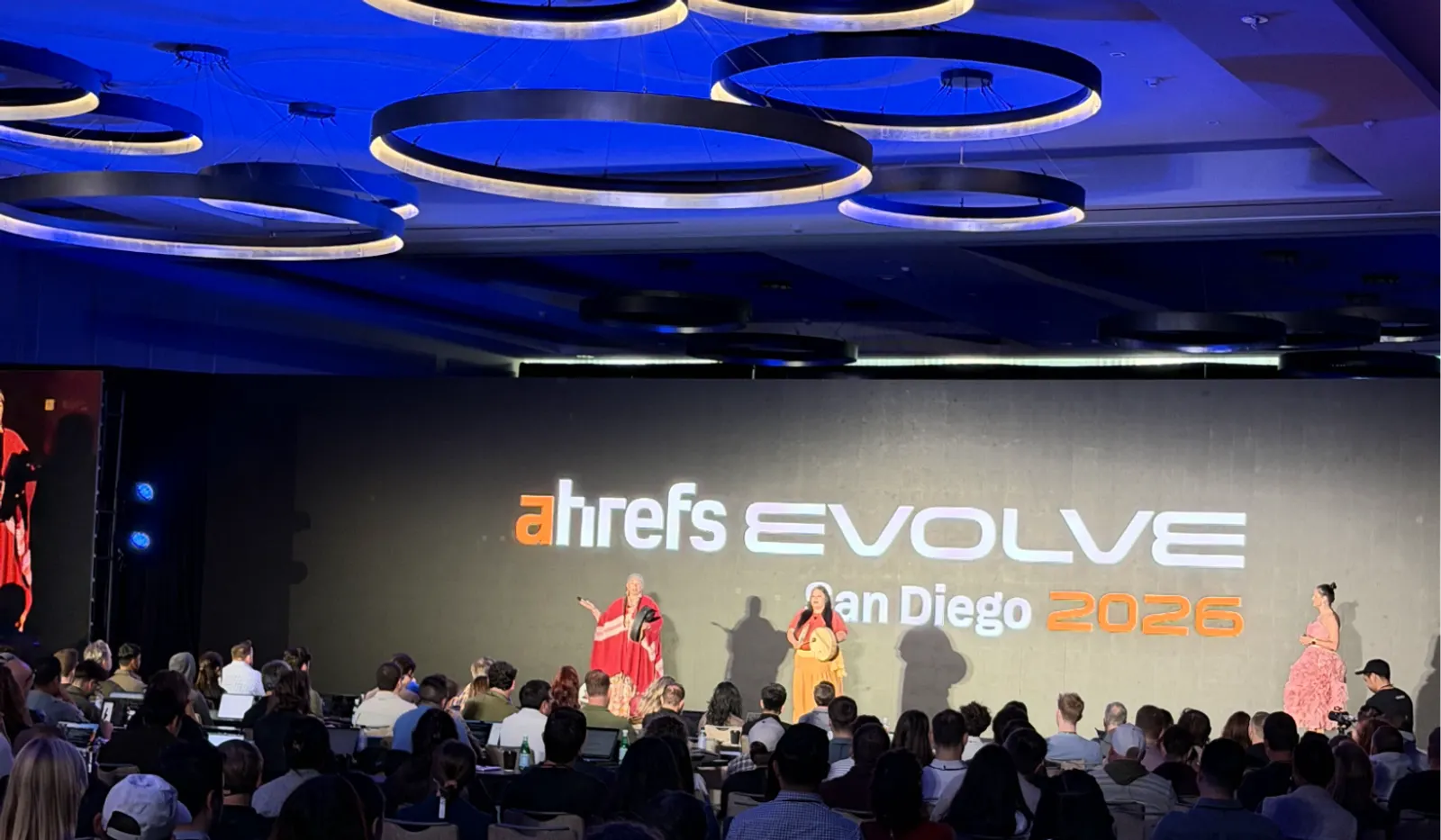
Our team attended the Ahrefs Evolve 2026 conference in San Diego, where dozens of presentations followed one another. The question driving the discussions this year was this one: how do you stay visible and profitable when search ends with an answer rather than a click? The terms AEO, GEO and AI visibility, still marginal two years ago, were at the heart of almost every presentation.
Here are the five lessons we brought back to Quebec, and what they concretely change for a business that wants to be found in 2027.
Ahrefs Evolve 2026 confirms the end of single-channel search
The opening observation was crystal clear and confirmed that people no longer search only on Google. They ask their questions to ChatGPT, Perplexity, Gemini and Google’s AI Overviews, and they read the answer without necessarily visiting a website.
For a business, the consequence is direct. Ranking first on Google is still valuable, but it is no longer the only way in. You also need to be the source the AI chooses to cite, or the brand it recommends when someone asks “what is the best provider for…”.
That is exactly what GEO covers: generative engine optimization. The term comes from a research paper published in 2023, whose authors already reported that certain content optimizations could increase a source’s visibility in generated answers by up to 40%.
Lesson one: distribution matters as much as content
Ross Simmonds, founder of Foundation Marketing, was categorical: an excellent article published only on your own site is no longer enough. It has to live elsewhere, on Reddit, on YouTube, in specialized media and on sites that link back to you.
The reason is simple. AI assistants draw their answers from a multitude of sources. The more present and consistent your expertise is across the web, the more likely it is to be picked up.
In practice, distribution should no longer be an afterthought. It has to be planned from the moment a piece of content is designed, just like the keyword or the structure. Guest posts and media coverage become levers of AI visibility, not just of link building.
Lesson two: being found is no longer enough, you have to be memorable
Ann Handley, from MarketingProfs, delivered one of the most important talks of the two days. AI can speed up many tasks, but some still require thought and humanity.
For GEO, the stakes are very concrete. An AI model has no reason to cite a generic text that repeats what a thousand other pages already say. It cites brands that bring real experience, a point of view or original data.
In other words, mass-produced content loses its value at the very moment it becomes easy to produce. Human expertise, on the other hand, becomes a competitive advantage.

Lesson three: AI visibility can finally be measured
For a long time, the question “is ChatGPT talking about us?” had no reliable answer. Kamila Olexa, from Ahrefs, showed that this is changing.
Tools now make it possible to identify the questions buyers ask AI tools, to compare your presence with your competitors’ and to track how it evolves over time. The indicators to watch look like this:
- how often the brand is mentioned in answers;
- how accurate what AI tools say about it is;
- its share of voice against competitors on the same questions;
- the traffic that actually comes from AI assistants.
Few businesses measure this data today. Those that start now get a head start, because you can only improve what you measure.
Wondering what AI tools say about your business? An AI visibility audit gives you a clear picture before you invest.
Lesson four: SEO remains the foundation of everything
Ethan Smith, CEO of Graphite, presented research that debunks several myths about SEO and AEO. The underlying message echoes what Google itself states in its documentation on AI features in Search.
“There are no additional requirements to appear in AI Overviews or AI Mode, nor other special optimizations necessary.”
Google Search Central
This sentence should not be read as an invitation to do nothing. Rather, it is a reminder that a fast, well-structured site with solid internal linking and useful content remains the basic requirement. Without these foundations, no GEO tactic holds up.
Smith also highlighted some good news. Few brands get significant visibility in AI answers today. The window of opportunity is still open.
Lesson five: AI multiplies your strengths without replacing people
Austin Lau, who built the marketing growth function at Anthropic, proposed a useful framework for any team. AI is there to automate repetitive tasks, to do what it does better than humans, to carry out projects that would otherwise not be profitable and to build your own tools.
What it does not do is replace strategic judgment. The time saved should be reinvested in analysis, thinking and client relationships.
What these lessons change for a Quebec business
These trends do not only concern big American brands. They already apply to SMBs, online stores and professional services firms in Quebec.
| What is changing | What no longer works | What to do in 2027 |
|---|---|---|
| Where people search | Relying on Google alone | Being present wherever clients ask their questions, including AI tools |
| What gets cited | Generic content produced in volume | Expert, original content that is easy to cite |
| How content is distributed | Publishing and waiting | Planning distribution from the design stage |
| What is measured | Rankings and traffic only | Adding mentions and share of voice in AI tools |
| The technical base | Isolated optimizations | Solid SEO that supports GEO |
Three questions make a good first diagnosis. What do AI tools say about your business, and are your competitors mentioned instead of you? Is your content structured to be cited, with clear and factual answers? Does your brand exist beyond your website, in the media, in reviews and on the platforms of your industry?
If you hesitate on any of these answers, that is a good starting point. GEO is precisely about working on these three dimensions in a structured way, building on the SEO already in place.
Ahrefs Evolve 2026 confirms it: SEO and GEO move forward together
The big lesson from Ahrefs Evolve 2026 fits in one sentence. SEO and GEO should no longer be seen as two separate projects, but as a single visibility strategy, wherever your clients search.
Businesses that move in the coming months will benefit from ground that is still largely unoccupied. To find out where you stand and improve your positioning on Google and in AI tools alike, simply book a strategy call.
FAQ
What is Ahrefs Evolve 2026?
Ahrefs Evolve 2026 is a conference organized by Ahrefs, the company behind the SEO tool suite of the same name. The 2026 edition was held in San Diego and focused on visibility in AI-generated answers, AEO and GEO. Search, content and growth specialists presented their research, their methods and their findings on the search of tomorrow.
Is SEO still useful with the rise of AI?
Yes, and perhaps more than ever. AI tools rely on pages that are indexed, fast, well structured and considered reliable to build their answers. Google even states that no special optimization is required for its AI Overviews beyond SEO best practices. Traditional SEO therefore remains the foundation of any visibility strategy in today’s generative engines and conversational assistants.
How can I tell if ChatGPT mentions my business?
The simplest method is to ask ChatGPT the questions your clients would ask, then note whether your business appears in the answers. For a reliable picture, it is best to test several phrasings, compare with your competitors and repeat the exercise over time. Specialized tools and AI visibility audits can automate this tracking across several assistants at once.